

As listeners of the podcast know, one of the issues I love to chat about on the show is the plumbing of central bank operations. In fact, the Macro Musings podcast is probably one of the few programs that regularly has guests who discuss the pros and cons of the Fed’s operating system. For example, in the past few years, I have had amazing conversations with Bill Nelson, Claudio Borio, Loretta Mester, Sam Schulhofer-Wohl, Roberto Perli, Brian Sacks Lorie Logan, and George Selgin on the good and bad of the Fed’s operating system.
While most of the U.S. debate on the Fed’s operating systems has centered on floor versus corridor operating systems, a quiet evolution has been unfolding abroad—one that introduces a third path. Major central banks like the European Central Bank, Bank of England, the Reserve Bank of Australia, and the Bank of Canada are beginning to chart a course toward what looks increasingly like a ceiling operating system. This shift, though subtle in language, carries significant implications for how monetary policy is implemented in a world of shrinking reserve balances.
In this week’s Macro Musings episode, Bill Nelson joined me to discuss this quiet but consequential transition underway in central banking. While some central bankers describe these frameworks as demand-driven floor systems, Bill notes that they behave more like ceiling systems—market rates are pinned down by lending facility rates rather than deposit facility rates—and therefore should be properly called demand-driven ceiling systems.
In this newsletter, I want to flesh out the details on a demand-driven ceiling system and illustrate what they look like using the the Bill Poole (1970) model. This is the model typically used to illustrate central bank operating systems. So, yes, this is going to be a more technical newsletter and not for the faint of heart.
Before we jump into ceiling operating systems, though, I want to show a behind-the-scenes video clip from the podcast. Bill and I had just wrapped up our conversation and I asked him about what in the financial system keeps him up at night. His answer will be the topic of the next newsletter, as it looks increasingly topical.
Demand-Driven Ceiling Systems: Latently Ample Liquidity
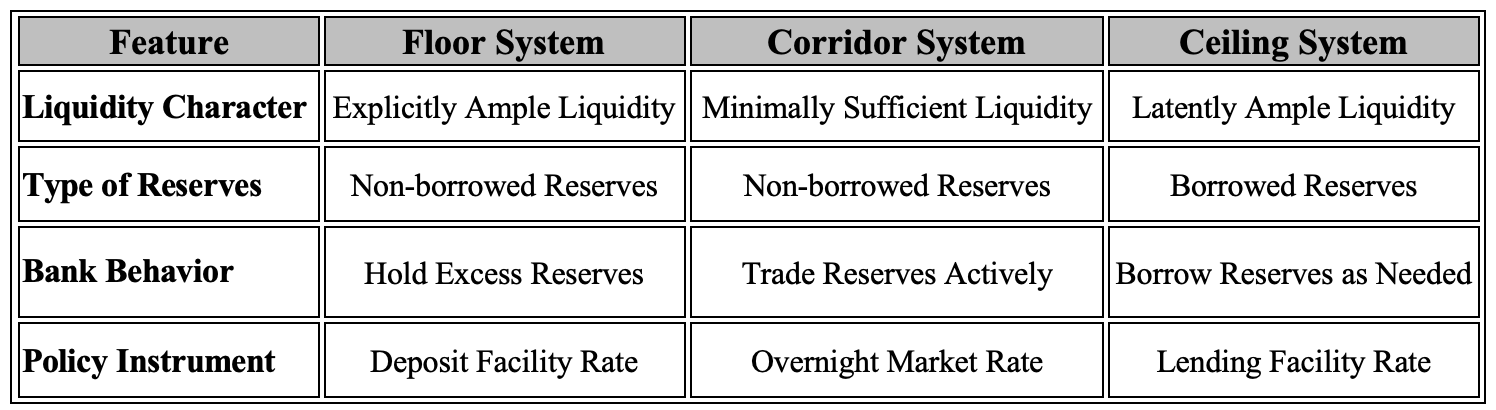
So what exactly is a demand-driven ceiling system? At its core, it’s an operating framework in which the central bank no longer maintains a reserve environment of liquidity satiation, as in a traditional floor system, but instead shifts to one of liquidity accommodation, where banks obtain reserves as needed through borrowing at a standing central bank facility. The key distinction lies in what pins down the overnight rate. In a floor system, the central bank supplies enough reserves to fully satiate demand, anchoring the market rate to the deposit facility rate. Banks hold ample liquidity and have little incentive to trade reserves or borrow. In a demand-driven ceiling system, by contrast, the central bank supplies reserves reactively, accommodating liquidity needs through lending. The overnight rate is therefore anchored by the lending facility rate.
In both operating systems, banks have ample access to liquidity—but the way that liquidity is provided differs in important ways. In a traditional floor system, liquidity is explicitly ample: the central bank supplies more than enough reserves to fully satiate banks’ demand, leaving no need for interbank borrowing or recourse to central bank lending. The overnight rate naturally aligns with the deposit facility rate.
In a demand-driven ceiling system, by contrast, liquidity is latently ample: the central bank stands ready to meet banks’ reserve needs through lending operations, but it does so only when banks actively demand reserves. The market rate is pinned by the central bank’s willingness to accommodate liquidity needs at a standing lending rate. Both frameworks provide effective monetary control and financial stability, but the mechanism—pre-supplied versus on-demand reserves—marks a fundamental operational distinction.
Of course, in between the floor system and ceiling system is the corridor system—something we have talked a lot about on the podcast. The differences among the three systems are summarized in the table below. Before we illustrate them graphically, let’s see which central banks are actually feeling the demand-driven ceiling system vibes.
Feeling the Demand-Driven Ceiling System Vibes
Okay, now that we better understand this new operating system, which central banks are actually embracing it? As mentioned earlier, the Bank of England, the European Central Bank, the Reserve Bank of Australia, and the Bank of Canada have all announced actions that move them toward a ceiling operating system. Let’s briefly look at each of these central banks in turn.
The Bank of England (BoE), is the avant garde of this group. It decided in 2018 that eventually it would transition away from a floor system to a demand-driven operating system. As part of this journey, a new short-term repo facility was introduced in 2022 that allows BoE counterparties to repo unlimited amounts of reserves. This demand-driven repo framework is still a work in progress, but BoE officials are telling its counterparties to get ready to repo!
The European Central Bank (ECB) is not far behind after announcing in March 2024 that it would be transitioning to a demand-driven ‘soft floor’ operating system. The system would similarly rely on its marginal refinancing operation (MRO) facility—a repo facility—to pin down interest rates even as it says its deposit facility rate will be what guides the stance of monetary policy. As Bill Nelson noted, however, the ‘soft floor’ language is a bit of a misnomer since ECB is setting up a ceiling system.
Similarly, the Reserve Bank of Australia (RBA) announced in 2024 that it would be abandoning its floor system and moving to an “ample reserves system with full allotment.” This means banks’ demands for reserves will be satisfied via open market repo operations reserves and will determine the quantity of reserves in the banking system.
Finally, the Bank of Canada (BoC) can also be seen as starting a journey toward a demand-driven ceiling system even though it claims to be running a floor system. The BoC decided in January 2025 that it would keep its deposit rate below its policy rate to help “reinforce the effect of the Bank’s Overnight Repo (OR) operations.” The spread is small, but pushes the BoC in the direction of a demand-driven ceiling system.
The Bill Poole (1970) Model
So what does a demand-driven ceiling system look like graphically? The Bill Poole (1970) model can help us see how the demand-driven ceiling framework will work in practice. However, it is helpful to show all three operating systems—the corridor, the floor, and the ceiling—as they have historically developed since the Great Recession.
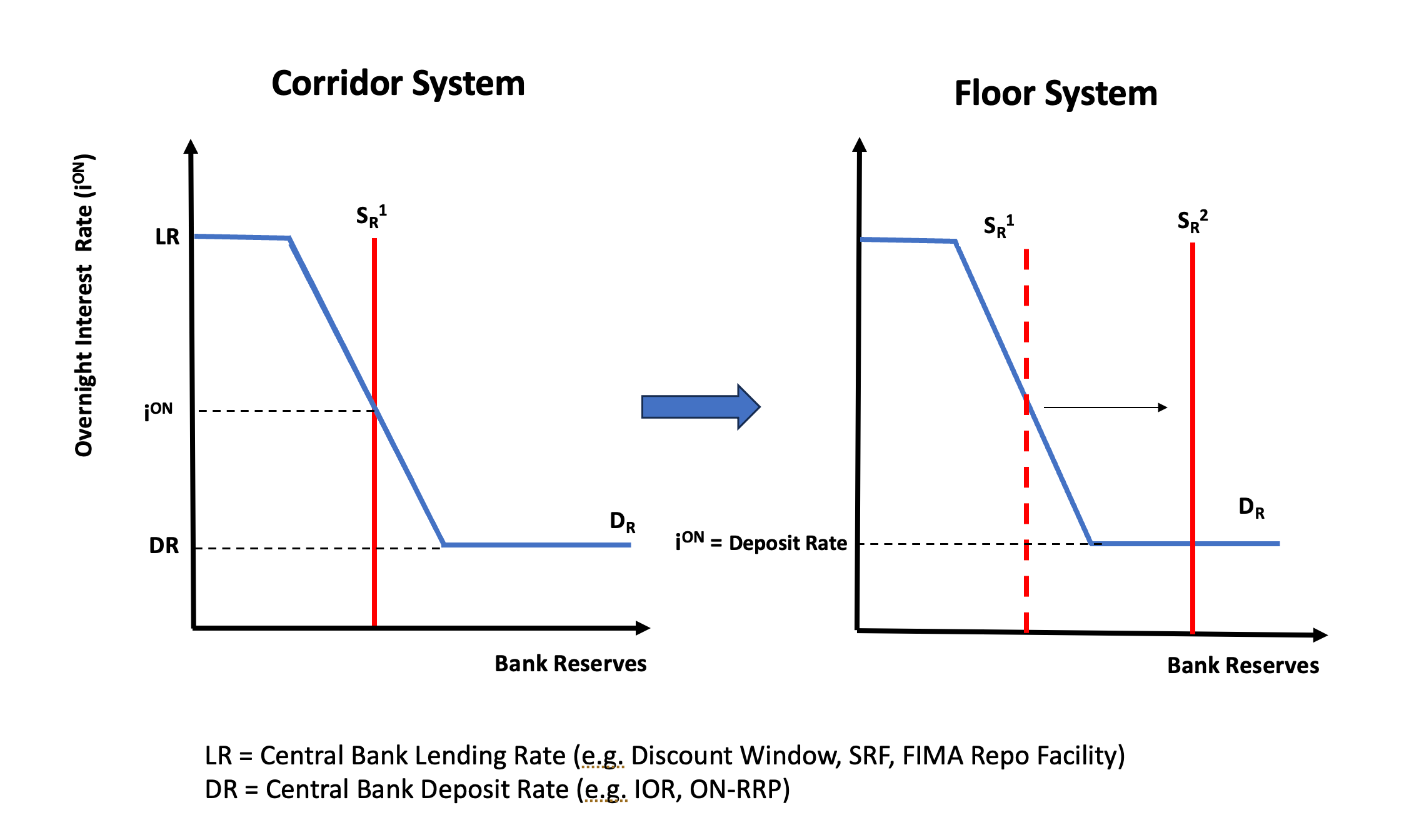
Before the 2007-2009 period, many central banks relied on a corridor operating system which is illustrated in the left-hand side of the figure below. However, the large-scale asset purchases during the Great Recession and thereafter caused a surge in reserve supply—shifting the red line to the right—and pushed the market onto the flat portion of the bank reserve demand curve. The system became a floor: reserves were abundant, and the overnight interest rate collapsed to the deposit rate.
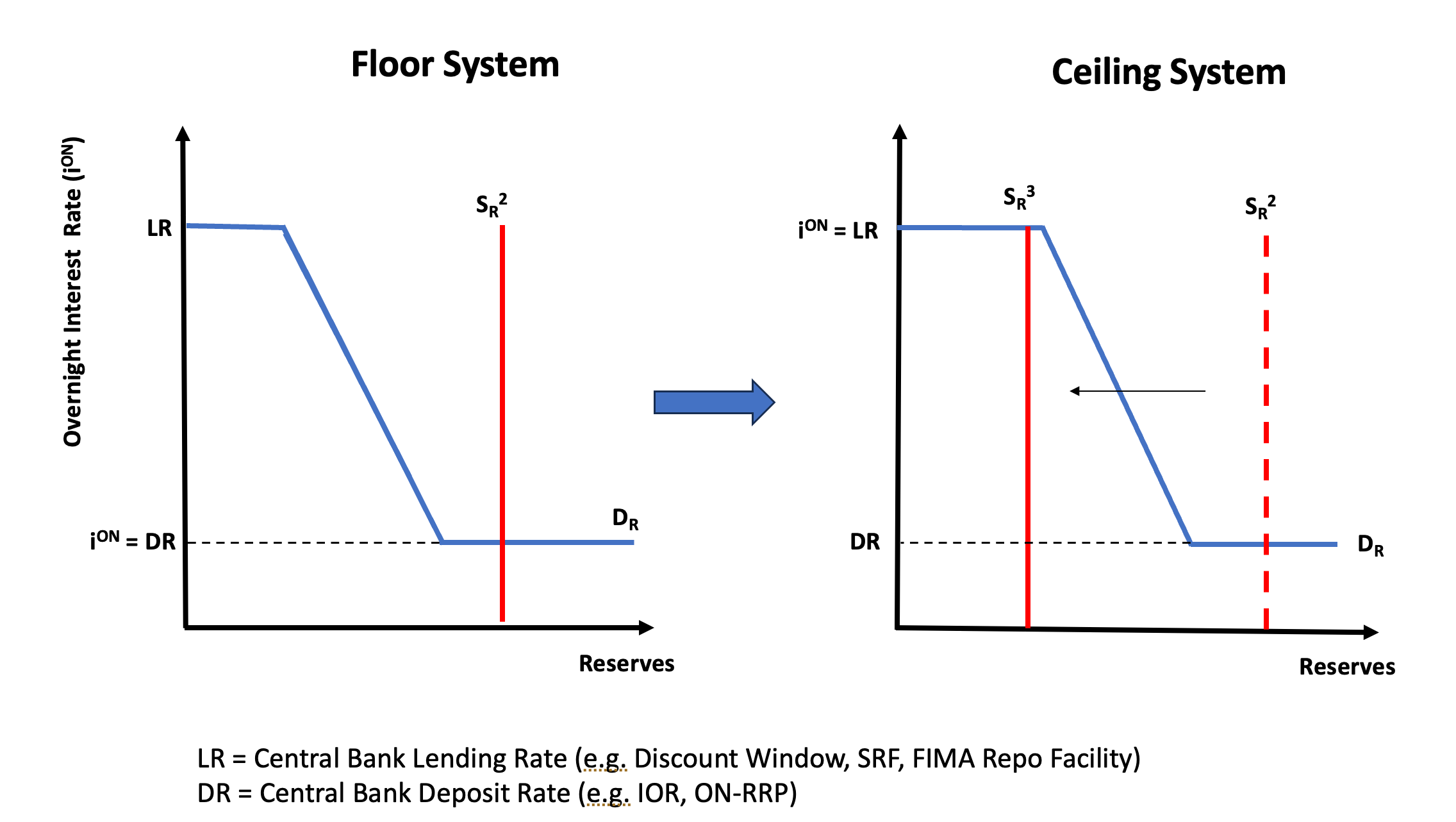
After the crisis, QT begins and (non-borrowed) reserves begin to shrink. If this process is allowed to persist, the central bank operating system would fall back into a corridor system. If QT persists even beyond that, the central bank operating system would traverse the corridor system and lands on the ceiling as seen in the figure on the right below.
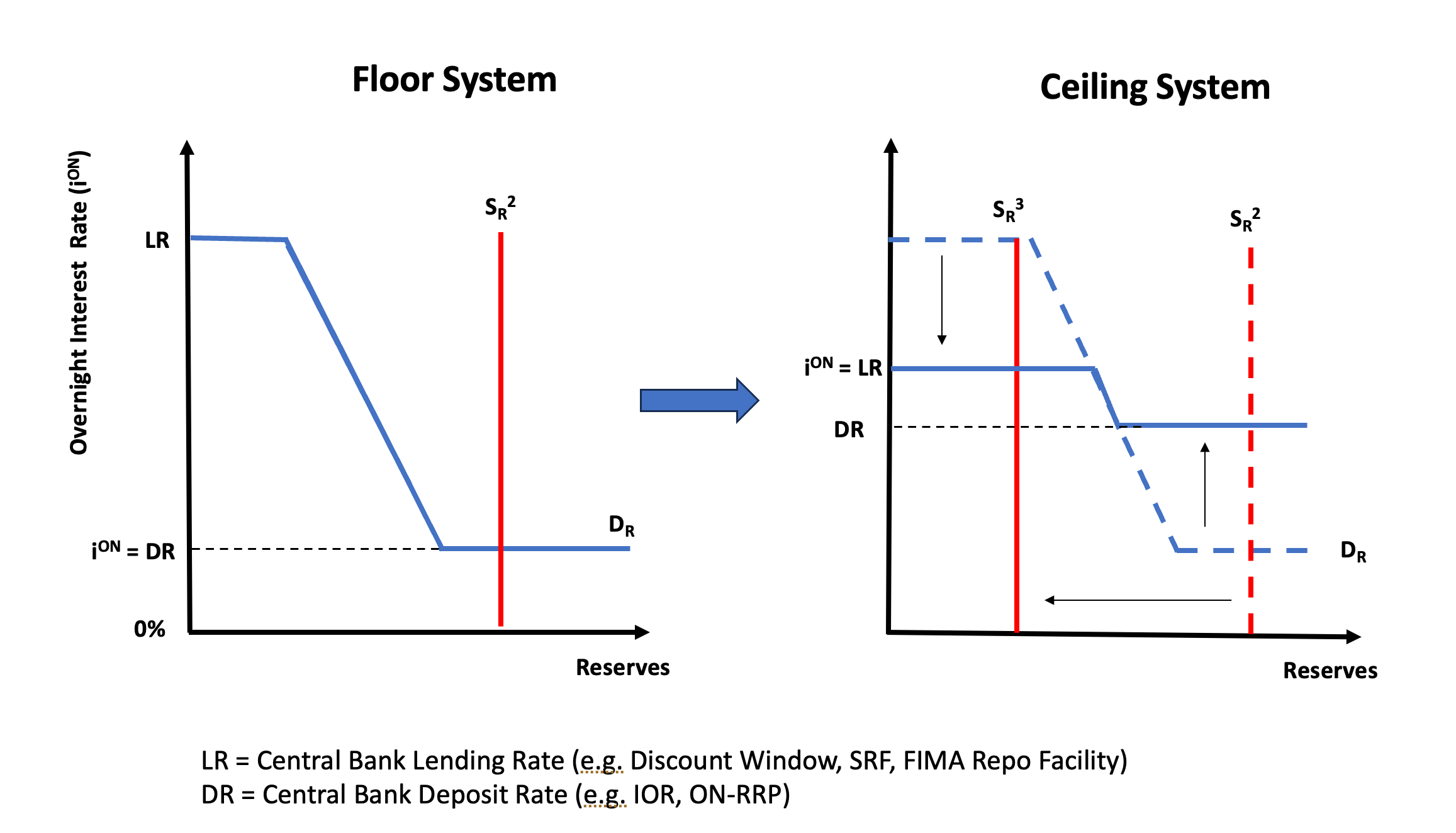
However, this figure is missing an important detail: most central banks moving toward ceiling systems have very narrow corridors, often just 10–15 basis points. So a more realistic ceiling system might look more like the figure below on the right. Even though, the language is not always clear, this is destination point of the journey now being traveled by the BoE, the ECB, the RBA, and the BoC.
Finally, Another Option: Tiered Reserve Operating System
Okay, if you have made it this far in the newsletter, you really do love central bank operating systems or are just a glutton for punishment. I will reward your dedication with one more alternative operating system for the central banks: a tiered reserve system. Central banks like the Norges Bank of Norway or the Swiss National Bank have adopted such systems. It can be seen as a compromise between a floor and corridor system. It compensates some bank reserves at the central bank’s deposit facility—like a floor system—while other reserves earn nothing at the deposit facility and therefore encourages banks to economize on holding such reserves—like a corridor system. In the video above, former Cleveland Fed President Loretta Mester explains the tiered reserve system approach and why it might be useful for the Fed to consider as it shrinks its balance sheet. This is from a podcast she did with me late last year.
Conclusion
As discussed above, the shift toward demand-driven ceiling systems marks a quiet but consequential evolution in central banking. While central banks may avoid the term “ceiling system,” their frameworks increasingly feature its defining traits: market rates anchored by standing lending facilities and reserves provided reactively rather than preemptively. This transition reflects both a pragmatic response to shrinking reserve balances and a broader rethinking of how best to implement monetary policy in a post-QE world.
What’s striking is how convergent these global shifts have become, even as each central bank couches them in slightly different language. Whether it’s the BoE’s “demand-driven repo facility”, the ECB’s “soft floor”, or the RBA’s “ample reserves with full allotment,” the common thread is a move away from liquidity satiation and toward liquidity accommodation—a demand-driven ceiling in all but name.
This transition deserves more attention in the U.S. debate over the Fed’s operating system. As Bill Nelson has noted, these foreign frameworks offer valuable insights into what a more responsive, elastic system might look like—especially if the Fed eventually finds itself navigating a world of tighter reserve conditions.
"if you have made it this far in the newsletter, you really do love central bank operating systems or are just a glutton for punishment" like one year after you posted it I still come back for more punishment
The demand driven approach is more efficient, getting temporary liquidity into banks when and where it is needed. Problem is, it masks identifying underlying problems at banks that might be insolvency problems, rather liquidity problems. That happened in 2019 when the Fed's overnight lending facility balance, and overnight interest rates, shot up, and all the lent money went only to a couple of banks. Pam Martens (https://wallstreetonparade.com/2022/02/when-repos-blew-up-in-2019) tried to delve into this, but never got a full explanation from the Fed. Now, Jerome Powell is accepting that mega banks can hold far less in capital than their balance sheets suggest (https://bettermarkets.org/newsroom/new-fed-research-shows-wall-street-megabanks-are-undercapitalized-and-pose-needless-risk-of-failure-crashes-and-bailouts/), making the possibility of a world black swan event more likely. Not to mention the threat of the failed hedge fund basis trade and proposals to set up a hedge fund bailout tool (https://www.youtube.com/watch?v=PIWwph9vUQg&t=1s). No liquidity window is capable of fixing these fundamental flaws with our U.S. financial system.